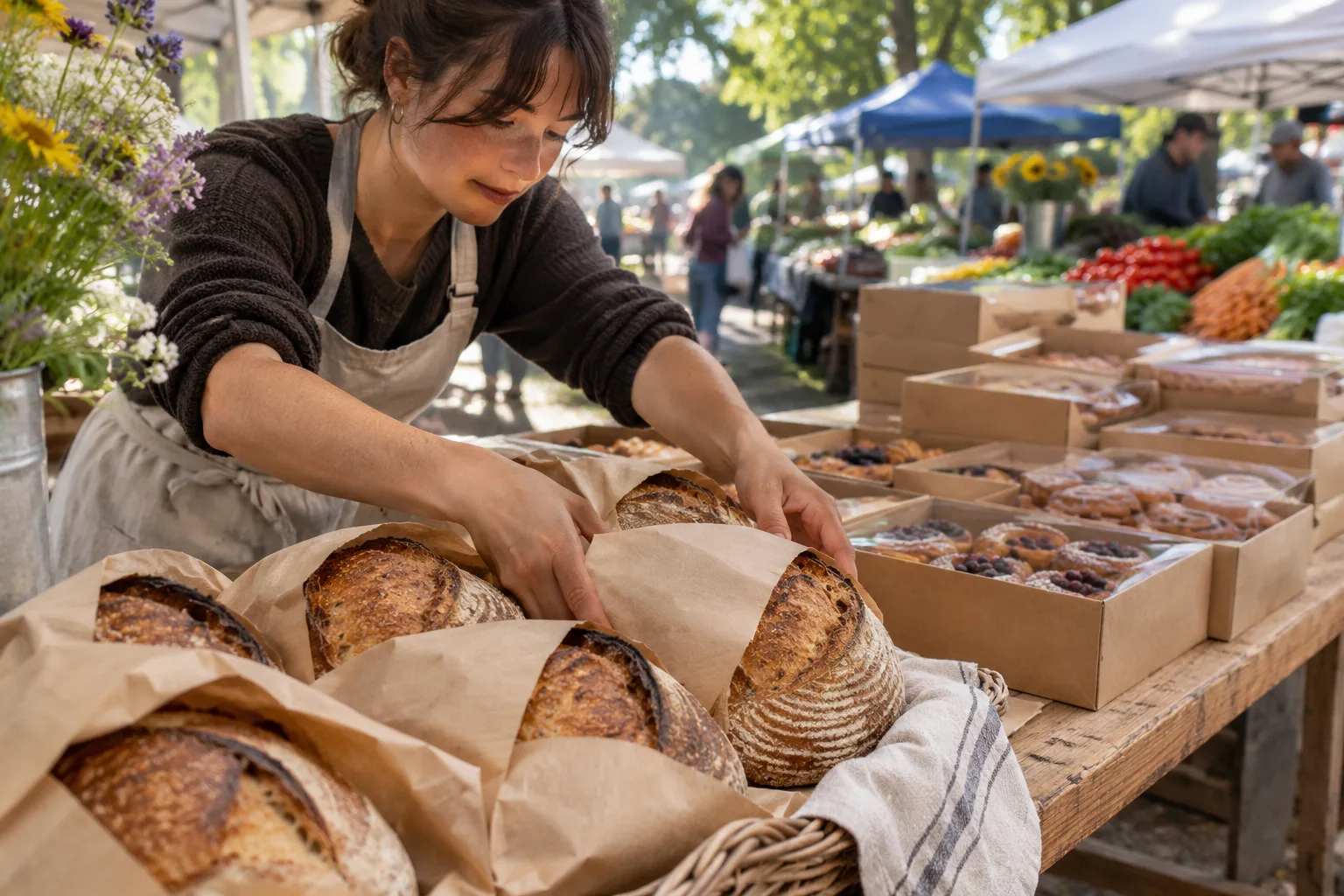
A farmers market gives a small food business the opportunity to meet customers in person and learn what they buy again. A weekly booth can be an affordable way to test a product, provided the market accepts the concept and the food is prepared and sold under the applicable rules.
FIND MARKETS THAT ACCEPT YOUR PRODUCT
USDA maintains a searchable directory of local food markets. Use it to identify potential markets, then visit their official websites or contact the managers. Some markets prioritize agricultural producers or restrict prepared-food vendors. Others have separate categories for baked goods, hot food and crafts.
Read the application, seasonal schedule, booth fees and vendor rules. Ask about category limits and whether your production method, including a home kitchen if applicable, is accepted.
CHECK THE FOOD BUSINESS REQUIREMENTS
Describe your recipes and intended sales method to the responsible state or local regulator. Packaged baked goods, prepared meals, beverages and products made at home may fall into different categories. Ask about permits, labeling, approved facilities, food safety, sampling and any temperature-control requirements.
Market approval and regulatory approval are separate matters. Obtain both as applicable before selling.
PLAN YOUR FIRST INVENTORY
Use a small menu with a standard batch yield. If possible and permitted, take preorders so you know how much to produce. Keep records of inventory taken, sold and returned, including samples and waste.
Suppose you take 40 packaged items priced at $7 each. Each costs $2.40 to produce and package. The full batch costs $96. Market fees, transport, labor and allocated overhead total $125, and you assume payment fees of 3%.
At 30 items sold, revenue is $210 and payment fees are $6.30. The example produces a $17.30 shortfall after the full batch and other entered costs. At 40 items sold, it leaves $50.60 before taxes and omitted costs.
Plan inventory with actual demand. The cost of unsold products still belongs in the market-day calculation.
CREATE A SIMPLE BOOTH
Include approved food protection, a stable display, clear prices, applicable labels, payment options and storage or temperature control as required. Check tent-weight and safety rules. Have a plan for rain, wind, waste and safe transport.
Help customers understand the product quickly: show the size, flavors, ingredients or required allergen information, and how to order again if that sales channel is permitted.
MAKE EACH MARKET A LEARNING OPPORTUNITY
Record sales by product, repeat requests, customer questions, weather and the time spent preparing and serving. Review the results before the next market.
A steady market business grows when its inventory, schedule and pricing reflect the people who actually buy from it.